Google’s Spam Update Just Completed: Here’s What Happened

By Neil Patel
Occasionally, Google rolls out their spam update which just ensures that the results on Google aren’t filled with spam.
Because if a user clicks on a spammy result, and if this continually happens, it creates a terrible experience and people would stop using Google.
They don’t give much detail on the spam update on their website, but luckily for you, we have two things that help us determine what the changes were.
The first thing we have is we track over 900 million domains on the web, so this allows us to see patterns.
The second, which is more relevant for this update is at our agency, NP Digital, we have 100 experimental sites that use AI-written content. The purpose of those sites isn’t to “game” Google, they are more so to figure out how Google perceives AI-written content. And I will go into more detail on what happened with those sites later in this post as the results were interesting.
Purpose of the update
As in the name, Google’s main goal is to reduce spam. Now they have multiple types of spam updates, such as in July 2021 they had a link spam update.
This update didn’t specify if it was link spam-related or just overall spam.
But when we look at the 900 million plus domains we track, here are the categories that got affected the most in a negative way globally.
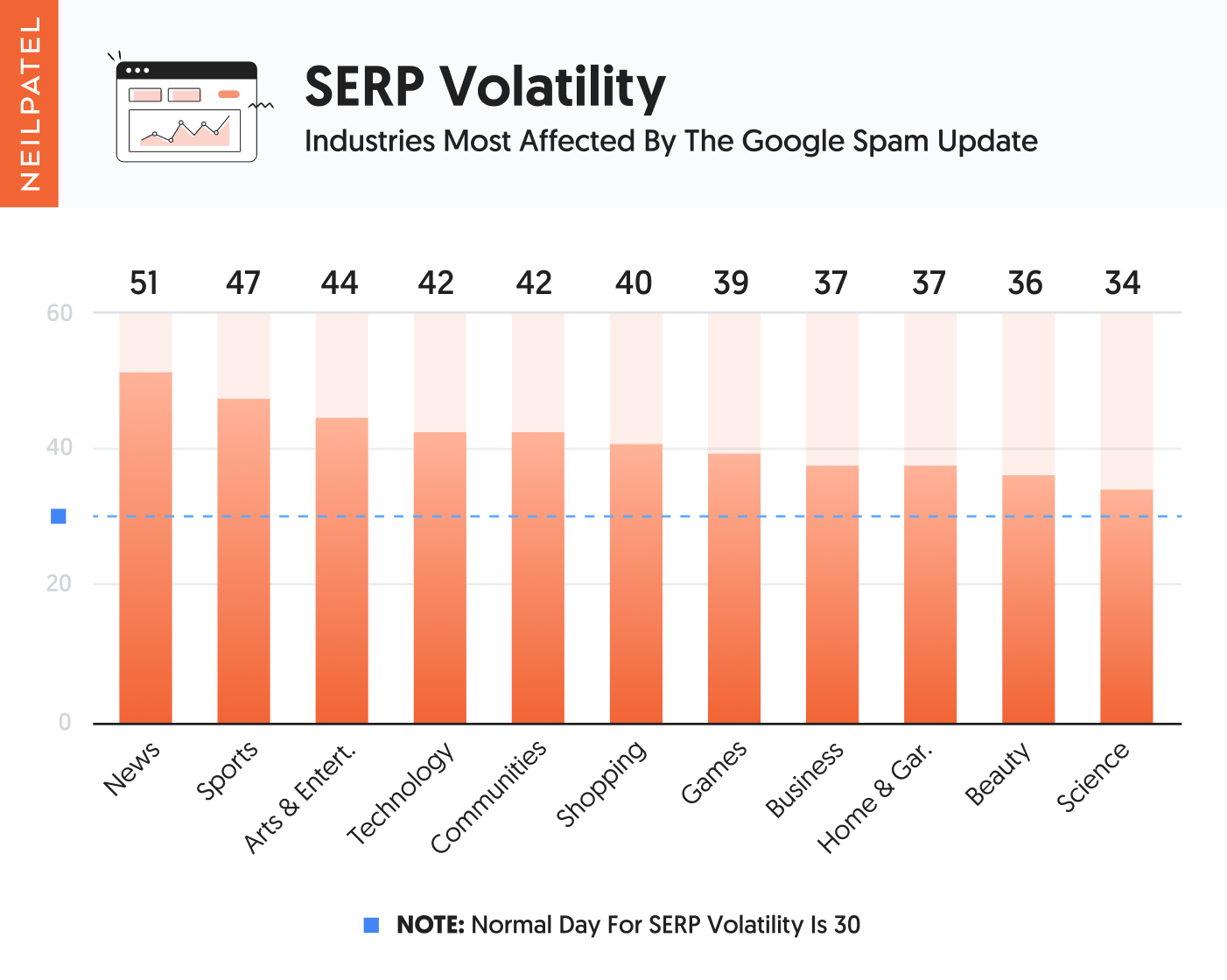
As you can see from the chart above, news and sports sites got affected the most. Followed closely by arts and entertainment and technology and community sites.
Most of these sites are heavy content-based and not product oriented.
When we looked at the sites affected here’s what we found:
- Thin content – most of them didn’t have amazing content… a lot of them had thin content. And to clarify that, by thin content, I don’t mean low word count, I mean content that really didn’t provide much value. In essence, the content was surface level and once you finished reading it you didn’t get many insights or any actionable points or value.
- Poorly created meta tags – a lot of the websites affected had pages with duplicate meta tags or ones that were obviously written for search engines and not humans.
- Keyword stuffing – shocking people are still keyword stuffing. Of the affected sites most of them didn’t keyword stuff, but roughly 3.89% of them did. Whether it was in their content on meta tags, they were using keywords in an excessive way that made the reading experience not ideal.
As you know there are many other factors in SEO. We just couldn’t find any other major patterns. From a surface level, some of the things they looked at seem kind of similar to the helpful content update.
We also looked at the backlinks of the sites that lost the most traffic we couldn’t find any patterns. Now, this doesn’t mean Google did or didn’t look at links as a …read more
Source:: Kiss Metrics Blog