Finding Keyword Opportunities Without Historical Data


Posted by Imogen_Davies
At Google’s Search On event in October last year, Prabhakar Raghavan explained that 15% of daily queries are ones that have never been searched before. If we take the latest figures from Internet Live Stats, which state 3.5 billion queries are searched every day, that means that 525 million of those queries are brand new.
That is a huge number of opportunities waiting to be identified and worked into strategies, optimization, and content plans. The trouble is, all of the usual keyword research tools are, at best, a month behind with the data they can provide. Even then, the volumes they report need to be taken with a grain of salt – you’re telling me there are only 140 searches per month for “women’s discount designer clothing”? – and if you work in B2B industries, those searches are generally much smaller volumes to begin with.
So, we know there are huge amounts of searches available, with more and more being added every day, but without the data to see volumes, how do we know what we should be working into strategies? And how do we find these opportunities in the first place?
Finding the opportunities
The usual tools we turn to aren’t going to be much use for keywords and topics that haven’t been searched in volume previously. So, we need to get a little creative — both in where we look, and in how we identify the potential of queries in order to start prioritizing and working them into strategies. This means doing things like:
- Mining People Also Ask
- Scraping autosuggest
- Drilling into related keyword themes
Mining People Also Ask
People Also Ask is a great place to start looking for new keywords, and tends to be more up to date than the various tools you would normally use for research. The trap most marketers fall into is looking at this data on a small scale, realizing that (being longer-tail terms) they don’t have much volume, and discounting them from approaches. But when you follow a larger-scale process, you can get much more information about the themes and topics that users are searching for and can start plotting this over time to see emerging topics faster than you would from standard tools.
To mine PAA features, you need to:
1. Start with a seed list of keywords.
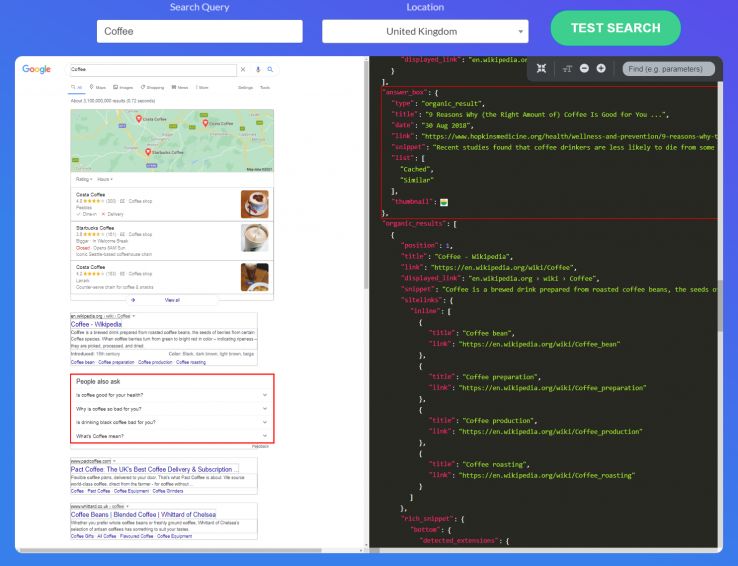
2. Use SerpAPI to run your keywords through the API call – you can see their demo interface below and try it yourself:
3. Export the “related questions” features returned in the API call and map them to overall topics using a spreadsheet:
4. Export the “related search boxes” and map these to overall topics as well:

5. Look for consistent themes in the topics being returned across related questions and searches.
6. Add these overall themes to your preferred research tool to identify additional related opportunities. For example, we can see coffee + health is a consistent topic area, so you can add that as an overall theme to explore …read more
Source:: Moz Blog