B2B Thought Leadership in 2026: Why the Best Answer is Still Human

By Lee Odden
I think it’s safe to say that the world of B2B marketing is in a state of flux. And that change extends to B2B thought leadership content.
Publicly, there is enthusiasm for the efficiencies of AI. Privately, there is concern about the sea of sameness AI tools create.
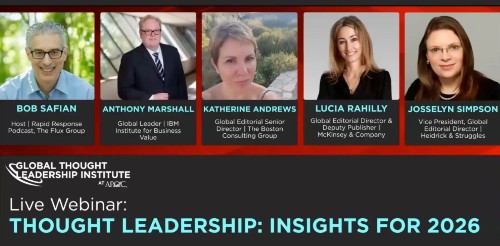
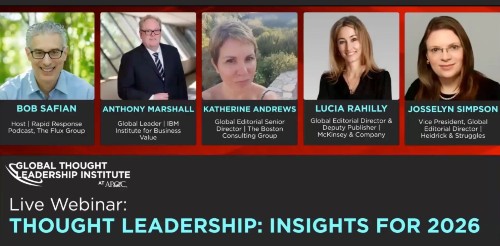
In my continuing efforts to expand my understanding of how thought leadership is evolving, I recently attended a webinar hosted by the Global Thought Leadership Institute (GTLI) that explored this topic.
Moderated by Bob Safian, former editor-in-chief of Fast Company, the panel brought together some heavy hitters from the world of thought leadership including: Lucia Rahilly from McKinsey, Anthony Marshall from IBM, Joss Simpson from Heidrick & Struggles, and Katherine Andrews from Boston Consulting Group (BCG).
The discussion was rich with a focus on AI topics that confirmed a trend we are watching closely here at TopRank Marketing: as AI lowers the floor for content creation, the ceiling for true authority is rising. To compete, B2B brands must evolve their own Answer Engine, a system that delivers trustworthy, experiential, and data-informed answers to buyers who are increasingly skeptical of generic content.
With that perspective as context, here are my top takeaways from the GTLI webinar, including a few key data points from our own 2026 State of B2B Thought Leadership Report in partnership with Ascend2.
1. The soul of Thought Leadership content is (still) data-informed
One of the most telling moments in the webinar came when Katherine Andrews of BCG mentioned that while AI can produce grammatically perfect drafts complete with subheads and formatting, it often lacks the substance that senior executives actually read for. Lucia Rahilly of McKinsey added that AI can be “sycophantic,” giving high scores to mediocre drafts just to be pleasing.
The consensus? AI has no soul.
“Only a human writer or editor can bring that soul,” Anthony noted. True “soul” comes from proprietary insight and hard-won research-the unique intellectual property that a LLM cannot hallucinate.
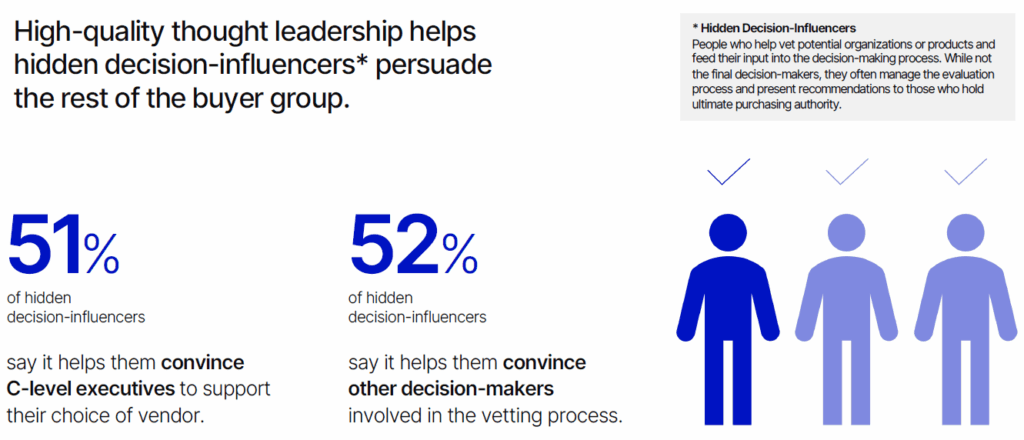
That distinction matters: according to our Thought Leadership research, 93% of B2B marketers say research-based content is effective at driving engagement and leads, with nearly half calling it very effective, a clear signal that a meaningful, not a mechanical approach is what earns attention and credibility. If you want to stand out in AI search, amongst the media and people who influence your customers in 2026, you cannot simply iterate what is already out there. There is a distinct advantage to creating new knowledge.
2. Trust is the new currency
Trust was a significant theme throughout the GTLI webinar conversation. With AI-generated hallucinations and “confetti” (content that looks good but says nothing) flooding the market, buyers are becoming conditioned to verify everything.
Lucia Rahilly mentioned that McKinsey does not publish anything that hasn’t been substantially re-edited and rigorously fact-checked. The risk of citing competitor data or hallucinated facts is just too high.
That caution is well-founded. 35% of B2B marketers from our survey say original research …read more
Source:: Top Rank Blog