How Best Answer Thought Leadership Drives Visibility, Credibility and Conversion


By Lee Odden

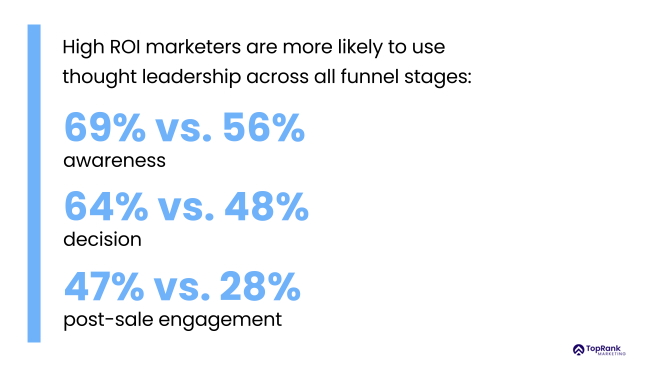
Most B2B marketers I talk to believe in thought leadership. And there’s plenty of research supporting that belief including our State of B2B Thought Leadership in 2026 study with Ascend2 which found that 97% of senior B2B marketers say thought leadership is critical to full-funnel success.
At the same time, less than half of those same marketers extend thought leadership content to engage and retain customers after the sale.
In a time when there’s more pressure for marketing to prove a return than ever, that gap is an important signal for B2B marketers looking for opportunities for impact. For most companies, thought leadership is a brand play: something you do to elevate awareness and interest, then hand off to demand gen and sales to convert.
The problem is, status quo thought leadership content has become commoditized and isn’t architected to create value across the entire customer lifecycle, nor is it differentiated beyond text based research reports.
The opportunities to fully embrace the benefits of strong thought leadership across the customer lifecycle are in part driven by changes in buyer behavior. Outside of the impact of AI on content discovery and creation, the B2B buyer environment has changed:
- Buying groups have grown from 3-5 to 13 stakeholders (Forrester)
- 67% of buyers prefer a rep-free experience (Gartner)
- Buyers engage an average of 10.2 channels during their journey (McKinsey)
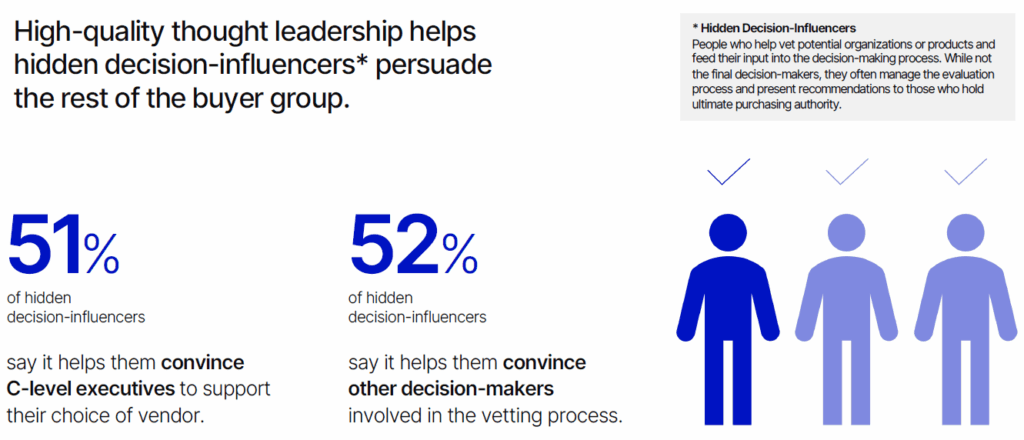
B2B thought leadership content directed solely at senior level decision makers is no longer enough to build credibility, trust and decision confidence to the larger buyer groups and the fragmented nature of discovery.
When AI can create the appearance of thought leadership in minutes, the proliferation of standard content formats makes every brand blend in and few stand out.
The question worth answering goes beyond whether thought leadership matters, to how to architect and activate it to more effectively drive visibility and earn credibility with larger more diverse buyer groups and buyer networks. At the same time, how can thought leadership helo create the conditions for conversion across the full buying journey – including contributing to retention and growth after the sale.
Best Answer visibility: how thought leadership answers questions buyers are asking
Long before a buyer engages with your brand, they are researching. Typing questions into Google. Prompting ChatGPT and Perplexity. Asking peers in Slack communities and on Reddit. Visibility and more importantly, credibility and trust for modern B2B brands means showing up with relevant answers in those places, in those formats, and when those questions surface.
As Rand Fishkin, Cofounder & CEO of SparkToro and Alertmouse recently shared on Linkedin,
“If you’re not present in the places *your* audience pays attention, it’s all over.”
Promotion vs. Attraction: B2B brands often build thought leadership content around ideas they want to reinforce about their solution or category. That content is likely more interesting to the marketers who produce it than to the audiences seeking answers. Thought Leadership content that promotes brand narratives may as well be invisible if it does not match the questions buyers are searching for.
To create the right answers we need to understand …read more
Source:: Top Rank Blog