How simple semantics increased our AI citations by 642% [New results]

By cdelprincipe@hubspot.com (Curt del Principe)
Like your weird uncle, nobody knows exactly how AI engines choose the sources they cite. But experiments are starting to point to ways you can get on their radar.
And as consumers increasingly turn to AI search for product and service recommendations, you really want to be on their radar. (Ironically, unlike your weird uncle, who you try to avoid.)
Today, I’ve got one such experiment that contributed to a 642% increase in citations by AI tools like ChatGPT.
And to the delight of you word nerds, it’s all about semantics. But first, everyone’s favorite part: The disclaimer!
The sum vs. the parts
Before you go any further, it’s important to know that this tactic is just one piece of a wider playbook our Growth team lovingly calls the “everything bagel strategy.”
“Our experimentation hasn’t [shown that] this one tactic is the key to better AI visibility,” says Amanda Sellers, HubSpot’s head of EN blog strategy. “What we’ve found is that the sum of the parts is what’s good for AI visibility.”
But if I covered all of those parts at once, this would be a novel, not a newsletter — so think of this more like part 1.
A little why behind the AI
“A human might be able to tell you what the sentence ‘Paris is cool’ means,” Sellers says. “But an AI engine without [immediate] context wouldn’t know if we’re talking about Paris, France, or Paris Hilton.”
AI tools can sound very human, but the way they understand language is very different from us.
Keeping with Sellers’ example about Paris, before reading, you would know from the start whether an article you clicked on was about travel tips or one about celebrity gossip. That context would be all you needed to understand the word “Paris.” AI models need a little more handholding.
One way to coddle their cold, metallic hands is with a framework called “semantic triples.”
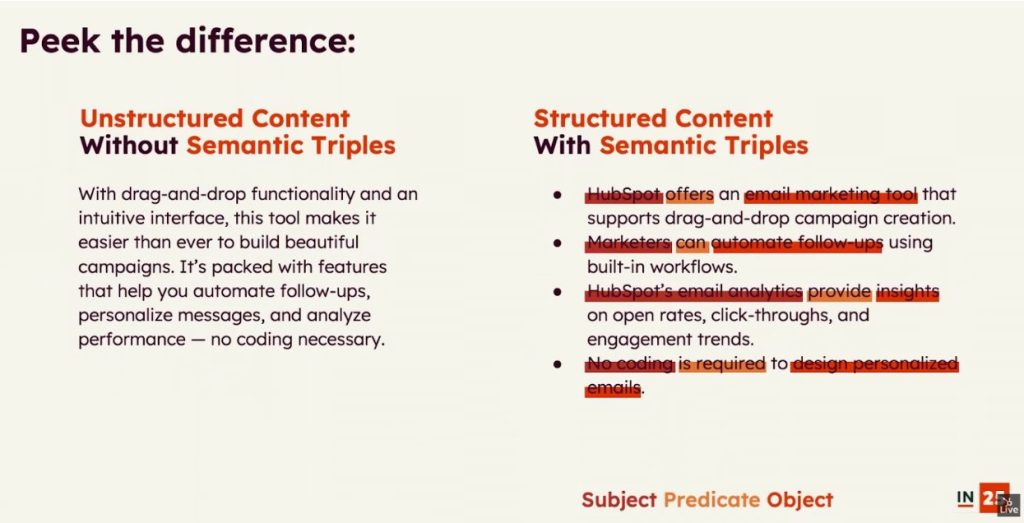
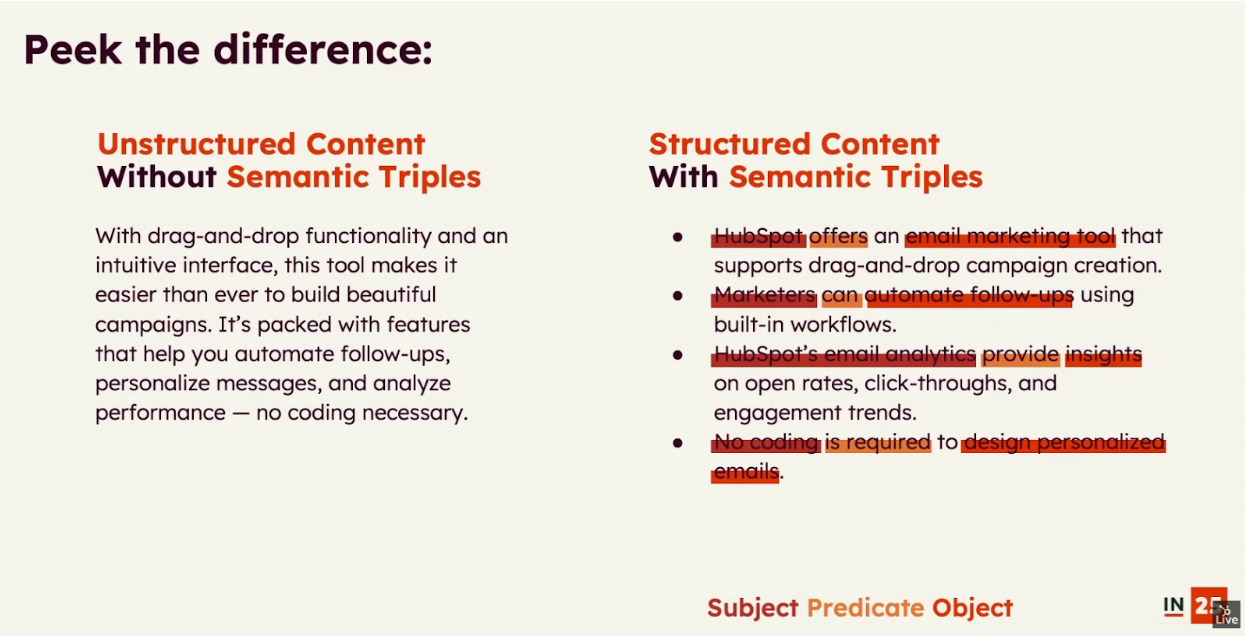
As simply as I can explain it: Semantic triples are a writing pattern that creates context using the sequence subject – predicate – object.
If you also pushed third-grade English out of your brain to make room for Lord of the Rings trivia, here’s a very quick recap of what those mean:
- Subject: Who or what a sentence is about.
- Predicate: Information about (or the action of) the subject.
- Object: The noun or pronoun that receives that action.
A real-world marketing example might look like: “HubSpot (subject) can automate (predicate) email marketing (object).”
With only one sentence, I’m able to quickly guide a bot to connect HubSpot with email automation. Why does that matter?
“We want HubSpot to be associated with ‘marketing automation,’ so that when someone asks ChatGPT, ‘What’s the best marketing automation platform?’ we’re mentioned in that conversation.”
Semantics in action
During the experiment, Sellers’ team took key information on pages that they wanted AI models to understand, and rewrote it from paragraph format into a bulleted list …read more
Source:: HubSpot Blog