From MQLs to Meaningful Growth: The New B2B Marketing Playbook from Jon Miller

By Lee Odden
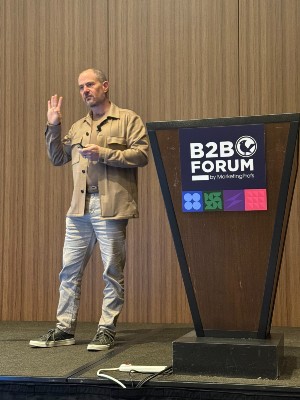
Known for shaping and influencing the last two decades of B2B go-to-market-from co-founding Marketo to his roles as founder and CEO at Engagio and CMO at Demandbase, Jon Miller returned to the MarketingProfs B2B Forum stage this week with a message that resonates with what a lot of B2B marketers are feeling right now: the playbook that earned marketing a seat at the revenue table just isn’t working anymore.
He made that point with a mix of smart insights and his signature dad-joke humor, but the message underneath was serious: the combination of AI, shifts in buyer behavior, and systemic short-termism is breaking the age of the MQL. Buyers now move in non-linear ways, operate anonymously longer, and expect relevance long before they make contact.
As Jon put it in our podcast conversation,
“The old playbook just isn’t working anymore… it’s falling apart because buying is complex, nonlinear, and increasingly impossible to map in a simple cause-and-effect system.”
The Four Problems Breaking the Old Model of B2B Marketing
Jon talked about four structural issues that explain why B2B marketing best practices that worked for years are no longer cutting it:
1. Marketing is not a gumball machine.
For too long, teams defended budget by implying linearity, as in, feed the machine, get leads out. But attribution tied to isolated actions simply doesn’t reflect how buying groups behave today or how decisions are made.
2. The tragedy of the commons.
Today when a new B2B marketing tactic comes on the scene, everyone rushes in and popularize/exploit it. But buyers adapt, and the tactic loses its effectiveness. With AI making content low cost and infinite, this cycle accelerates. Jon joked about personalization making every prospect feel “specifically irrelevant”.
3. A chronic underinvestment in brand.
This was pretty much the heart of Jon’s argument about the broken B2B marketing playbook. By the time sales reaches out, 81% of buyers already have a preferred vendor in mind. Jon emphasized brand’s role in shaping early emotional preference-echoing what he told me in our interview: “Brand actually IS revenue marketing… it determines who buyers contact first.”
Meaningful, unique, defensible positioning (“MUD”) is no longer optional. Jon says it’s the only way to influence the invisible majority of buyers who never appear in your CRM.
4. Short-termism.
Pipeline pressure has turned marketers into “hamsters on a quarterly wheel.” Gating everything, over-interpreting form fills, and over-rotating on new business have collectively damaged the buyer experience and stunted long-term growth. In our Beyond B2B podcast interview, Jon actually mentioned how tools themselves baked in this bias: “There are deep structural reasons why SaaS has over-rotated to net-new business at the expense of customer lifecycle.”
What Works in the Age of AI
The emerging playbook Jon described aligns tightly with the reality we see every day at TopRank Marketing: buyers are invisible longer, AI intermediates more of the journey, and content abundance increases the importance of sources. Increasingly, sources of information are just as, or more important than the content itself.
Jon stressed three pillars of differentiation we need to pay attention …read more
Source:: Top Rank Blog