This behavioral science principle can make your billboard go viral, here’s how


By Phill Agnew

Is billboard advertising still relevant today? Yes, all because of costly signaling. This behavioral science principle states that expensive signals indicate higher quality or status.
Although a broader concept about human behavior, costly signaling absolutely applies to advertising. What, after all, is the value of a social media ad? While highly effective, social ads are cheap, so everyone can buy them and crowd the space. But a billboard? That takes some real money.
So, let’s dive into how the costly signaling applies specifically to billboard advertising. Then, I’ll share some top viral billboard examples.
What is costly signaling?
Costly signaling theory is the idea that the higher cost you put into something, the more other people will value it.
Sounds simple right? Well, I do have two caveats. The first is that costly signaling reflects perceived cost. People still need to interpret and assign value to signaled information. Secondly, the signal of cost in these cases is reliable because only individuals who can afford to send the signal possess the signaled quality.
To put it in marketing terms, costly signaling means that the more resources you put into sharing your message, the higher people will rate it. Goes beyond money and includes time, effort, pain, or any sort of expense spent to make the message more persuasive.
I think advertising executive Rory Sutherland puts it perfectly: “The meaning and significance attached to something is in direct proportion to the expense with which it is communicated.”
Costly Signaling Example
Costly signaling goes beyond textbooks and can be seen in the real world. A 2013 study titled “Extreme Rituals Promote Prosocially” analyzed how expenses can increase religious donations.
The study took place in Mauritius during the Hindu festival of Thaipusam. The researchers wanted to see if the effort and pain the worshipers put into their ritual affected the amount they donated to the local temple.
Researchers studied two types of rituals:
- A low-ordeal ritual. This consisted of a group that only sang and prayed.
- High-ordeal ritual (Kavadi). This ritual was very intense. Participants pierced their skin with needles and hooks, carried heavy structures, and walked barefoot uphill for over 4 hours.
Those who watched the low-ordeal singing group gave just 80 rupees as a donation, while those who watched the high-ordeal rituals gave 65% more, 132 rupees on average. In this case, observing pain made people value the ritual more.
I like to visualize costly signaling as a positive vector in which the two elements are directly proportional: higher cost = greater meaning.
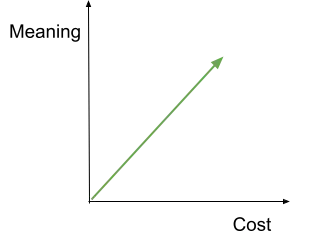
This is why asking your partner to marry you at a McDonald’s drive-thru is unlikely to succeed. Asking them after a 10-course tasting menu at a 3-star restaurant will have a higher chance of success.
Although you’re the same person asking the same …read more
Source:: HubSpot Blog