EAP Providers Have a Visibility Problem Beyond Social Media

Social Media Explorer covered this gap before. Mental health content is one of social’s biggest categories. It drives a lot of organic engagement, and users are genuinely eager to engage with the content. This topic has even been covered extensively on here by the Headlines Team in their blog, “Mental Health Is One of Social Media’s Biggest Content Categories.”
But the behavioral health employers who should be part of that conversation are largely absent from it. Worse still, they are almost entirely absent in search too.
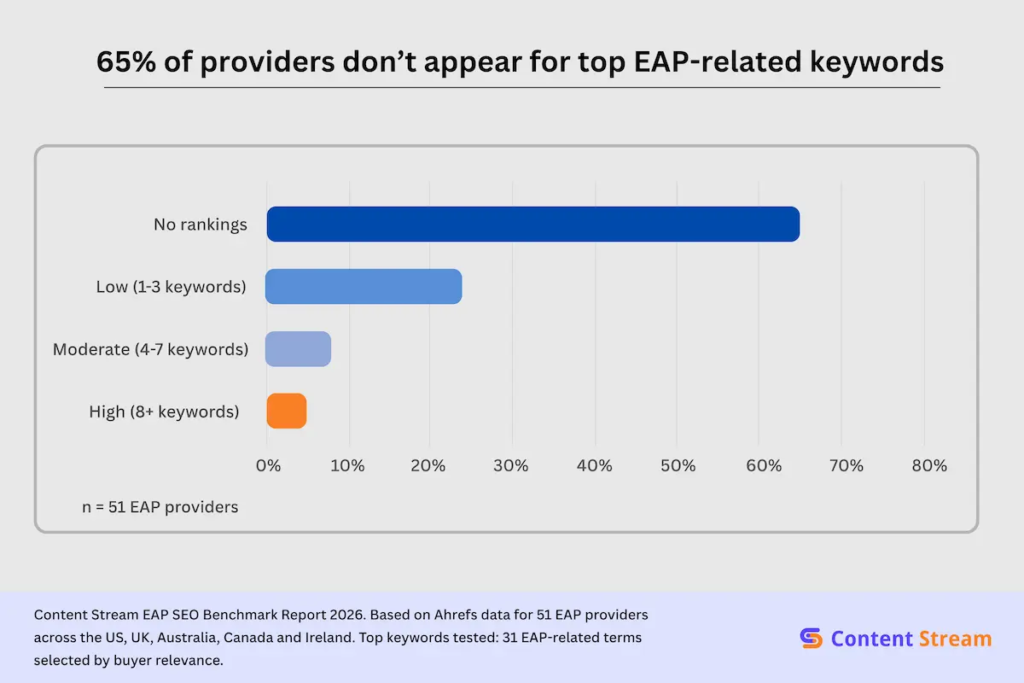
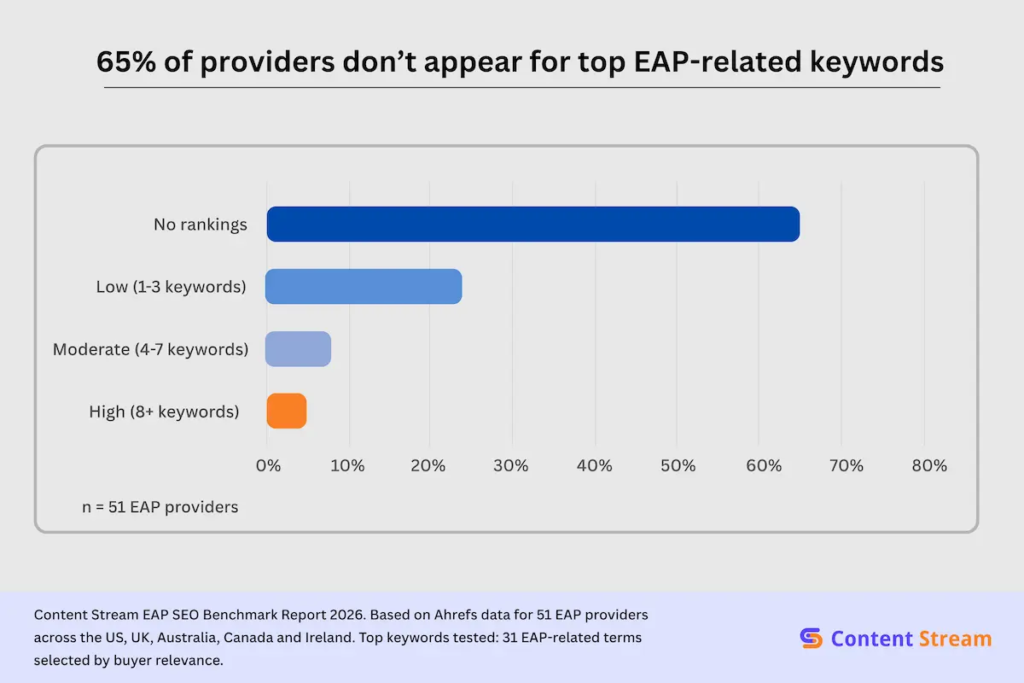
At Content Stream, we looked at the organic footprint of 51 Employee Assistance Program (EAP) providers across 5 markets for a recent report. And we found supporting evidence: the audience is there, actively searching (we saw high search volumes), but most providers simply aren’t showing up.
Breaking down the data: EAPs are invisible in search
Here’s what the numbers in our report say:
- 65% of EAP providers don’t rank in the top 10 for any core EAP-related keyword, including terms like “EAP providers” and “workplace mental health support.”
- 45% of providers rely on branded search for most of their organic traffic. For 1 in 6, that figure is over 90%.
- 73% of providers have fewer than 200 indexed pages.
The overall pattern we saw was this: most EAP websites work less like a discovery channel and more like a directory listing. If you already know the brand name, you’ll find the site immediately in the top three positions. But if you’re an HR professional Googling “digital EAP” for the first time, you won’t find most providers.
Only a handful of platforms appear for these discovery queries, and they show up for most of the keywords. The rest are nowhere to be found.
The pattern is consistent with the story social media already told: a large, active audience and a sector that doesn’t show up where the audience is looking.
Why do EAP providers have low discoverability?
For many of the keywords we evaluated, our team found that adjacent websites (government agencies, HR-tech comparison sites, and other wellness publishers) are holding most of the top spots for generic EAP terms.
So we have providers ranking less for keywords that they technically own. But that’s not news; visibility in search has always been skewed towards platforms with higher authority.
But EAP providers can actually win on the right playing field. That is, creating content only an EAP provider can write well, like
- Benchmarks
- Outcomes data
- Real-world implementation guides
Content along these lines carries real business value, and most of it is still wide open.
In my experience, publishing a few of these won’t immediately transform a provider’s organic visibility profile; authority like this takes consistency and time to build. But EAP platforms have a better chance to perform here than by creating generic “what is” content that large comparison sites already rank for.
How some providers are winning in search
A good number …read more
Source:: Social Media Explorer