ADA Title II Just Raised the Bar: How Small Fire Departments Can Hit WCAG 2.2 With WordPress

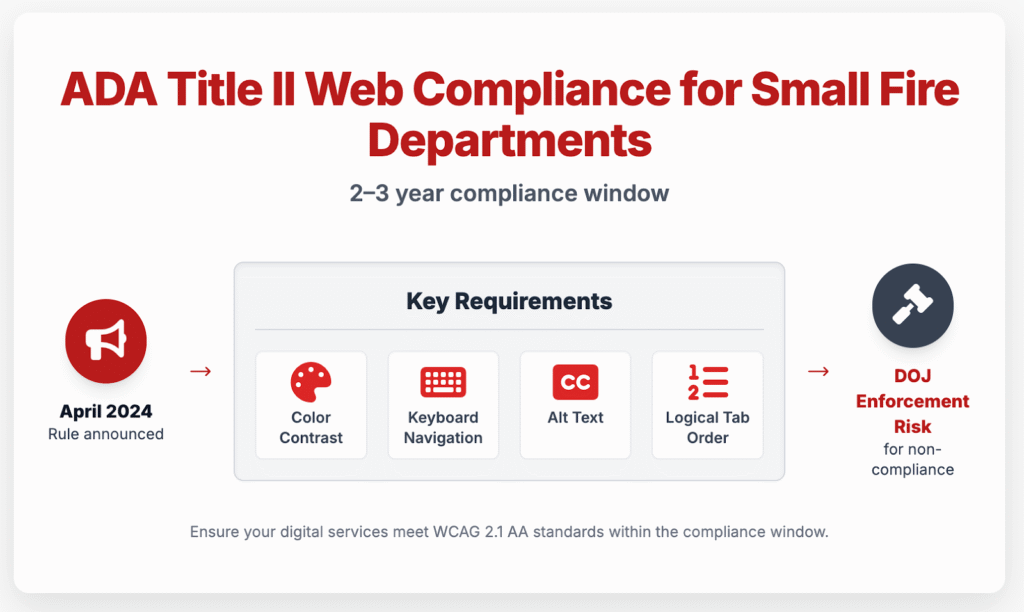

In April 2024, the U.S. Department of Justice quietly dropped a bombshell for local governments: a final rule under Title II of the Americans with Disabilities Act (ADA) requiring state and local websites to comply with the WCAG 2.2, Level AA standards. For massive state agencies with dedicated IT teams, it was an expected evolution. For volunteer-led fire departments that manage their own sites between emergency calls, it was a wake-up call.
Accessibility, once treated as a “nice to have,” is now a legal mandate—and it’s reshaping how civic institutions build and manage their online presence.
Compliance Is Now a Legal Obligation
The new rule establishes a two-year compliance window for most public entities, with smaller local governments granted up to three years. It mandates that digital content—including websites, online forms, and PDFs—must be accessible to users with disabilities.
That means every emergency alert, volunteer application, and fire safety tip must be navigable via screen reader, have proper color contrast, and maintain logical tab order.
Recent DOJ enforcement actions have already targeted small agencies. In 2023, a Florida municipality settled a case involving inaccessible fire-safety forms that lacked alternative text (alt text) and keyboard navigation. A New York county library system paid tens of thousands in remediation costs for similar oversights. The lesson? Waiting costs more than building right the first time.
A Louisiana Case Study in Getting It Right
While many departments are still scrambling to understand WCAG 2.2, the Independence Volunteer Fire Department (IVFD) in Louisiana got ahead of the curve. In partnership with BlakSheep Creative, a firefighter- and veteran-owned digital agency, IVFD launched a modern, mobile-responsive website that not only meets accessibility requirements but also improves emergency communication.
As featured in Before It’s News, BlakSheep’s redesign gives the department complete control over its content. Using WordPress, Elementor Pro, WS Form Pro, and Meta Box, the team created structured, ADA-compliant forms for smoke alarm requests, volunteer recruitment, and public inquiries.
“Accessibility isn’t just about compliance,” says Clint L. Sanchez, founder of BlakSheep Creative. “If someone can’t find or use your emergency form during a crisis, that’s not just a technical issue—that’s a safety failure.”
The Cost-Benefit Equation
Accessibility upgrades sound expensive, but most departments can reach compliance affordably by pairing the right tools with training. Sanchez estimates that a small fire department can achieve WCAG 2.2 conformance for under $10,000, primarily if it uses open-source platforms and modular plugins.
Compare that with a DOJ consent decree, which can exceed $50,000 in fines, remediation, and legal fees. Beyond cost avoidance, accessibility also improves SEO, boosts public trust, and helps departments attract younger volunteers who expect modern design.

A Practical Playbook for Fire Departments
BlakSheep recommends a phased approach for agencies beginning their accessibility journey:
- Audit Existing Content: Run automated scans using WAVE, axe DevTools, or Siteimprove. Identify color, …read more
Source:: Social Media Explorer



Author: Aaron