5 science-backed pricing tips from the U.K.’s top marketing podcast


By Phill Agnew

In
Customers found that the cheaper tickets felt like a worse value. Why? Researchers found that people more easily differentiate smaller numbers. The difference between 4 and 3 seems more salient than 9 and 8. So, customers were more likely to buy when the prices ended in smaller numbers £244 to £233), compared to those ending in higher digits (£199 to £188).
The takeaway is fairly simple. Next time you run a discount, make the sale price less than five. That’s just one piece of pricing advice that we’ve discussed on my podcast Nudge, the U.K.’s number one marketing podcast. Here are four more psychology-backed tips for pricing your products.
Table of Contents
- Break down your price.
- Show the price difference.
- Be transparent with your costs.
- Make the difference visible.
Break down your price.
Check out the two ads for a budget lunch from Huel. One shows the total cost of 21 meals (£78.96). The other breaks down the price per lunch ($3.76). Researchers found that breaking down the price per unit performed better with customers. Showing a lower price led shoppers to perceive that they were getting a better deal.
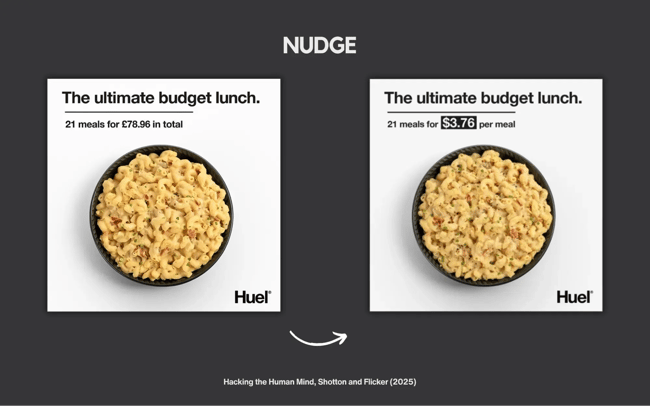
Richard Shotton and Michael Aaron Flicker tested ads very similar to this for their fantastic book Hacking the Human Mind.
In a study, 282 shoppers were divided into groups. Half were shown Sierra Nevada Pale Ale priced at $18.99 for 12 bottles. The other group was told the price per unit — $1.58 per bottle. Among those shown the per-bottle price, 28.6% said it was good or very good value (more than double the 13.7% who only saw the total price).
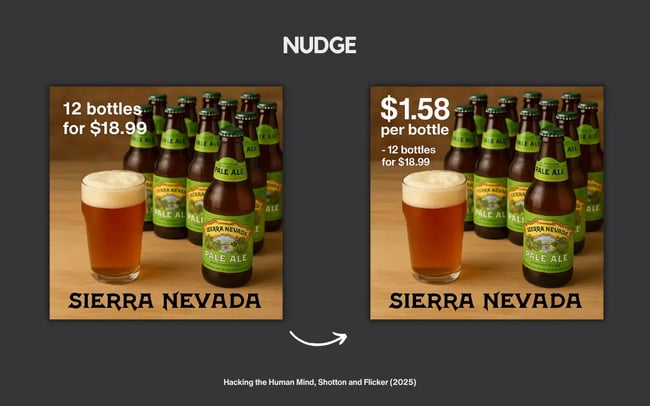
Framing the cost per unit made the purchase feel more reasonable and affordable.
Show the price difference.
Companies looking to upsell their audience need to pick the right framing. Take this 2019 experiment from David Hardisty at the University of British Columbia. Hardisty tested different pricing packages for New York Times subscriptions.
Group A saw two plans:
- A “Digital Access” subscription for $9.99/month.
- An “All-Access” subscription that included web access, the app, print newspapers, podcasts, and the crossword for $16.99/month.
Group B saw the same products described in a different way. The first plan showed a “Web + App” subscription for $9.99/month. The second plan, labeled “+ All the Extras,” was available for an additional $7/month.
Same total price. Different framing. But, Group B chose the premium plan two times as often. Why? Because $7 extra feels easier to justify than $17 total.
Want people to go premium? Don’t show them the full price. Use differential price framing and just tell them the surcharge.
<img src="https://53.fs1.hubspotusercontent-na1.net/hub/53/hubfs/pricing%20tips%2c%20show%20the%20difference.webp?width=650&height=406&name=pricing%20tips%2c%20show%20the%20difference.webp" width="650" height="406" alt="pricing tips, show the difference" style="margin-left: auto;margin-right: …read more
Source:: HubSpot Blog