
HubSpot AEO vs. Otterly: Platform or standalone tool?

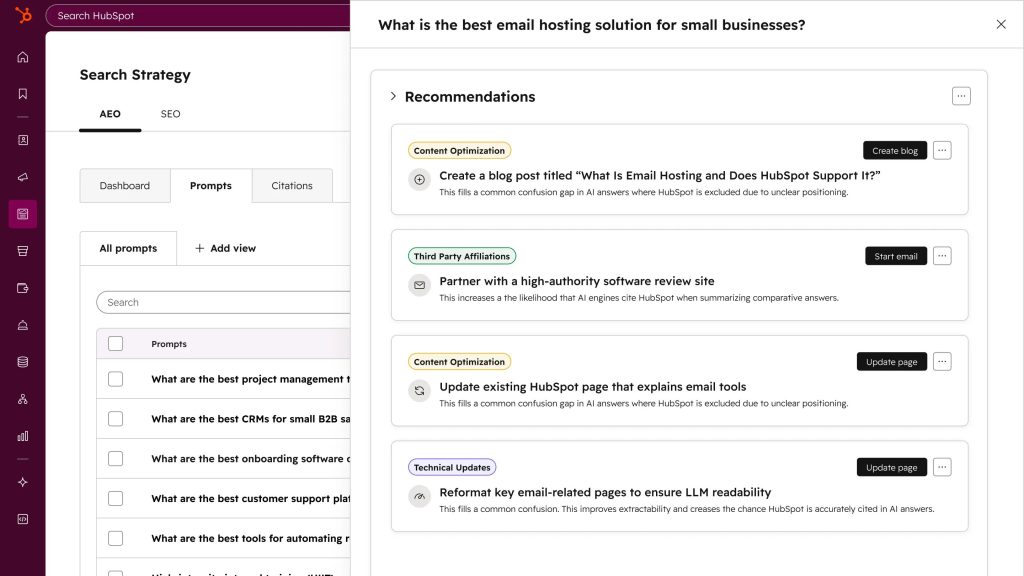
Here’s the question most teams are actually trying to answer: do you need a standalone tool to monitor how your brand shows up in AI search, or do you need something that connects that monitoring to the content and CRM workflows that let you act on it?
That’s the real difference between HubSpot AEO and Otterly. Both track your visibility in AI engines like ChatGPT, Gemini, and Perplexity. But what happens after the data comes in is where they diverge.
HubSpot AEO is a CRM-connected AEO solution built directly into the HubSpot platform. It surfaces visibility insights and routes them into content creation, campaign management, and pipeline tracking, without requiring you to switch tools. Otterly is a standalone AEO monitoring tool that tracks your AI visibility, provides reporting, and lets you export data via Looker Studio, an API, or an MCP server.
If you’re trying to decide between them, here’s an honest breakdown.
Table of Contents
- HubSpot AEO vs. Otterly: How are they different?
- HubSpot AEO vs. Otterly Features and Engines
- Which tool helps me act faster on insights?
- HubSpot AEO vs. Otterly Pricing and Capacity
- How Integrations and Workflows Compare for HubSpot Users
- AEO vs. SEO: Do I need both?
- What should I do first if I’m new to AEO?
- Frequently Asked Questions About HubSpot AEO vs. Otterly
HubSpot AEO vs. Otterly: How are they different?
HubSpot AEO is built into the HubSpot platform. It tracks how your brand appears across ChatGPT, Gemini, and Perplexity, then connects those insights directly to your CRM data, marketing campaigns, and content tools.
When it surfaces a gap, you can publish a blog post, schedule a LinkedIn update, or engage on Reddit without leaving HubSpot. The prompt suggestions it gives you aren’t generic industry templates — they’re built from what it already knows about your company, competitors, and customers.
Otterly is a purpose-built content intelligence platform for AI search. It calls itself “neutral and objective,” tracking from a first-person perspective on a daily basis. It covers a wider range of AI engines out of the box (ChatGPT, Google AI Overviews, Google AI Mode, Perplexity, and Microsoft Copilot), with Google Gemini and Claude available as paid add-ons.
Otterly offers strong standalone reporting and integrates with Looker Studio, a public API, and an MCP server. What it doesn’t do is connect that data to a CRM, marketing automation, or content creation workflow — that part is up to you.
The core decision lens: if your team just needs AI visibility monitoring and has a separate content workflow you’re happy with, Otterly works. If you want AEO insights to flow directly into the tools where you create content, run campaigns, and track pipeline, HubSpot AEO is the stronger fit.
HubSpot AEO vs. Otterly Features and Engines
Here’s a side-by-side look at what each tool actually does:


Related Articles

Brand tracking tools for scaling companies
By Jenny Romanchuk Brand tracking tools help growth marketers gauge what people say about the brand, whether it’s good or bad, and why they choose…

AEO prompt tracking for marketing teams
By juthompson@hubspot.com (Justina Thompson) You already track and analyze your SEO strategy — keyword rankings, organic traffic, SERP positions. But when a prospect asks ChatGPT,…

CRM data migration: A practical process overview
By HubSpot Staff CRM data migration is the process of moving data, workflows, and assets from one CRM to another. It matters because your CRM…

CRM administration: Roles and best practices guide
By HubSpot Staff After years of working alongside CRM administrators, I’ve learned the single biggest difference between CRM platforms that drive revenue and ones that…

CRM deployment: A step-by-step process for growing teams
By HubSpot Staff There’s an irony at the heart of most failed CRM rollouts: the technology almost never lets you down. The deployment does. More…