The Correlation Between Authoritative Links and Ranking [SEO Study]

By EricEnge

Posted by EricEnge
Over the past five years, our team at Perficient has conducted continuous studies to evaluate the lasting impact of links on rankings. These studies consistently show that links matter as a ranking factor, but they also show that Google is dialing up their emphasis on the quality/authority of those links. We can say this because of the strong correlation our most recent studies show between the Domain Authority (DA) and Page Authority (PA) of linking pages and the rankings of pages receiving the links.
Each year, Moz has graciously provided us with access to their Link Explorer index, where we obtain the raw data to perform our analysis. In these studies, we perform Spearman Correlation analyses to show how the following variables correlate with ranking:
- Number of links to the ranking page
- DA of links to the ranking page
- PA of links to the ranking page
Please note that Moz has never compensated us for including, or asked us to include, the DA and PA calculations — we have chosen to do that of our own volition. In fact, Moz staff only learned that we had done so in early October of 2020, even though we published the post with our findings on April 16, 2020 (to be honest, I was too busy to catch up with the Moz team and let them know). In short, there is no quid pro quo here.
Study methodology
Go ahead and jump down to the study results section if you just want to see how things turned out!
We have been conducting this study on a nearly annual basis since May of 2016. In 2016, we started with an initial query set of 6K queries, but have expanded to 32K queries over time. The queries were obtained by pulling keyword ranking reports for web sites in three different target market sectors, and then manually reviewed to remove any queries that were poorly formed or not relevant to that sector. The market sectors we looked at were technology, healthcare, and finance.
Here is the breakout of the size of the query sets across the five studies we have done so far:
- May 2016: 6K queries
- Aug 2016: 16K queries
- May 2017: 16K queries
- August 2018: 27K queries
- December 2019: 32K queries
Each of the expanded query sets includes all of the queries from the prior studies, which allows us to track the results on a consistent basis all the way back to 2016.
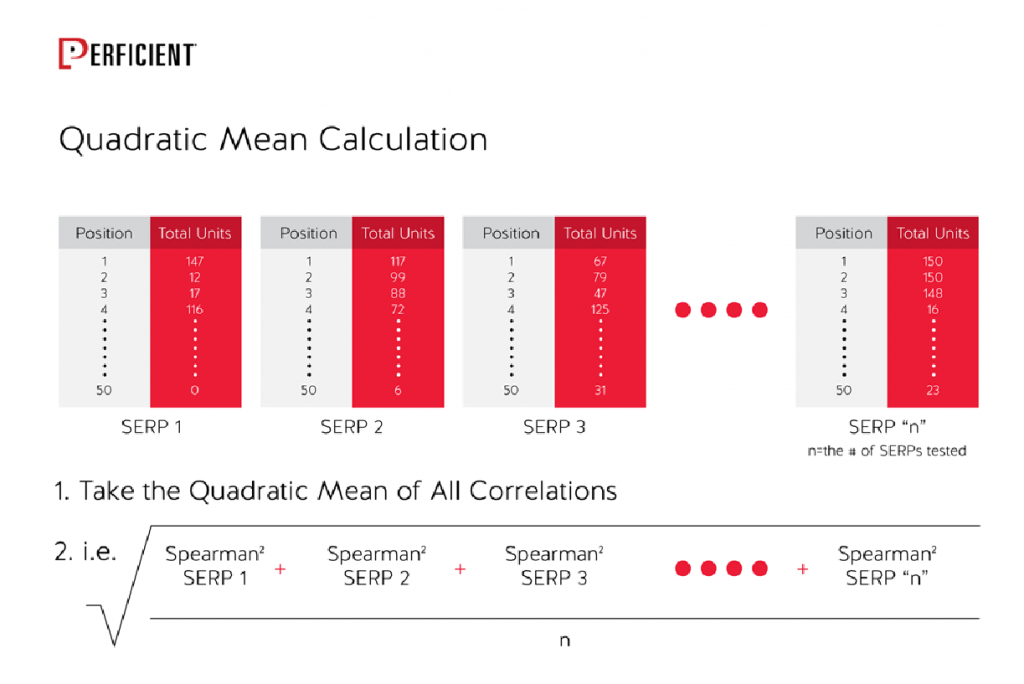
In putting together this study, I also consulted with two experts in statistics: Paul Berger of Bentley University, and Per Enge, formerly of Stanford University. Because of the nature and structure of the data set, it was decided that the best approach was to calculate the quadratic mean of the Spearman Correlation for all the queries in the study.
I went with this approach because it uses the square of the correlation variables (where the correlation value is R, the quadratic mean uses R squared). This is important because the correlation variable R is useful to know, perhaps, …read more
Source:: Moz Blog