
Six simple behavioral science tips to improve any marketing message (and the brands that get it right)


By Phill Agnew

Do you ever look at an ad and wonder, “What on earth does that mean?” That’s how I felt after viewing this Stripe ad.
Now, I love Stripe. Their product is tremendous in the world of payment processing, but this ad makes no sense. Not only is it confusing, but it’s missing all the elements that I think make for a good ad. The ad needs a refresh, and behavioral science can help.
Since starting the Nudge podcast, I’ve regularly interviewed researchers and other experts in order to glean insights from psychology and apply them to marketing. And over the past decade, I’ve come to believe that almost every message could be improved by behavioral science.
In this post, I’ve collected six successful messages with behavioral science principles behind them to prove my point. Once you see the science — and understand exactly why these ads work — using the same strategies to improve your own marketing messages becomes much simpler.
Six Successful Messages Using Behavioral Science Principles
1. Anchoring — De Beers
In the 1930s, only 10% of Americans bought diamond engagement rings. Most bought cheaper gems, spending a smaller proportion of their disposable incomes. To change buyer behavior, De Beers came up with a new anchor. They asked, “How can you make two months’ salary last forever?”
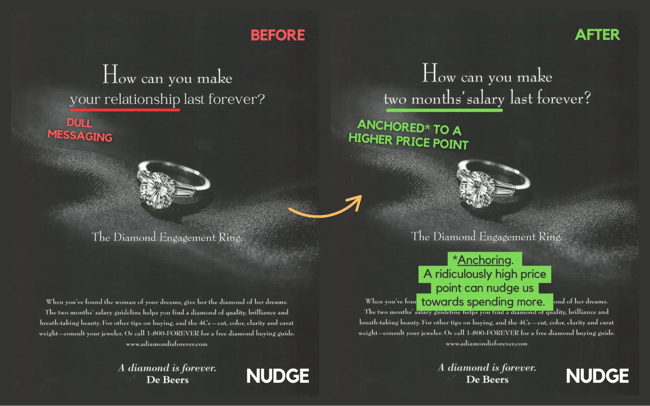
Two months’ salary was not the standard amount to spend on an engagement ring before this. But, the new anchor shifted perceptions of the norm. De Beers created a reference point (in this case, a higher price tag), which in turn influenced estimations of value. Buyers will spend more when it’s assumed that two months’ salary is what a ring should cost.
Today, 90% of engagement rings are diamond. And, Americans spend billions annually to purchase them.
2. Pratfall Effect — Avis
Rental car company Avis always lagged second for market share, behind Hertz. Most companies would hide this weakness, but Avis embraced it.
Behind this strategy is something known as the Pratfall Effect. Based on Aronson, Willerman, and Floyd’s research, the 1966 study found that we like smart people more if they have flaws. It boils down to the idea that if people seem too perfect, they’re not as easily liked. But if they make a mistake, they become a little more human like the rest of us, and thus more attractive.
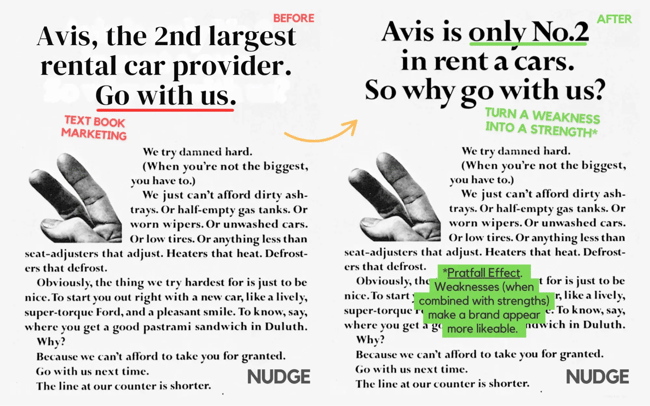
So, Avis took this to heart and decided to flaunt their second-place ranking, showing that they were still among the best but just shy of perfection. This way, their weakness became a strength by making them appear more likable.
3. Generation Effect — Gut Foundation
There’s a straightforward way to get someone to notice your ad: Remove a letter.
In a 2020 …read more
Source:: HubSpot Blog


