5 Tips to Invigorate Boring SEO Reports with Storytelling


Posted by chrisgiarratana
Add value to SEO reports with storytelling
Monthly SEO reports are a vital part of any SEO strategy because they provide an outlet to educate customers, show ROI, and guide the conversion for upsells.
While SEO reports are crucial in many ways, they are usually reduced to boilerplate PDF templates sent to clients each month with a generic message. If this describes your SEO reporting approach, you’re missing out on vital opportunities to retain clients and upsell with carefully crafted storytelling strategies.
SEO reporting has always been an important part of my deliverables. Whether I’m working with clients through my agency, StrategyBeam, or when I worked in a corporate team, I found that good reporting made a big difference with trust building and overall strategy. Regardless of who you’re working with — national brands or local businesses — I’ve found that solid SEO reporting helps ground the client relationship. Over the past eight years, I’ve been able to grow StrategyBeam to a mid-six-figure agency. Customer service and results have always been our bread and butter, and SEO reports help us show how we stand out from the competition, and create long-term relationships with our clients.
Be sure to incorporate SEO reports into your regular cadence if you are struggling to keep a client, or you just want a way to engage with your clients in a deeper way. Now, more than ever we need to show clients the value we bring to the table.
So, let’s take a look at the things all useful SEO reports should include, and how you can use storytelling tactics to build a relationship with your customers, prove your strategies’ value, and uncover upsell opportunities today!
1. Organic impressions, clicks, and CTR
While SEO has a broad reach, you need to get the right message to the right people if you want them to click through to your content and convert.
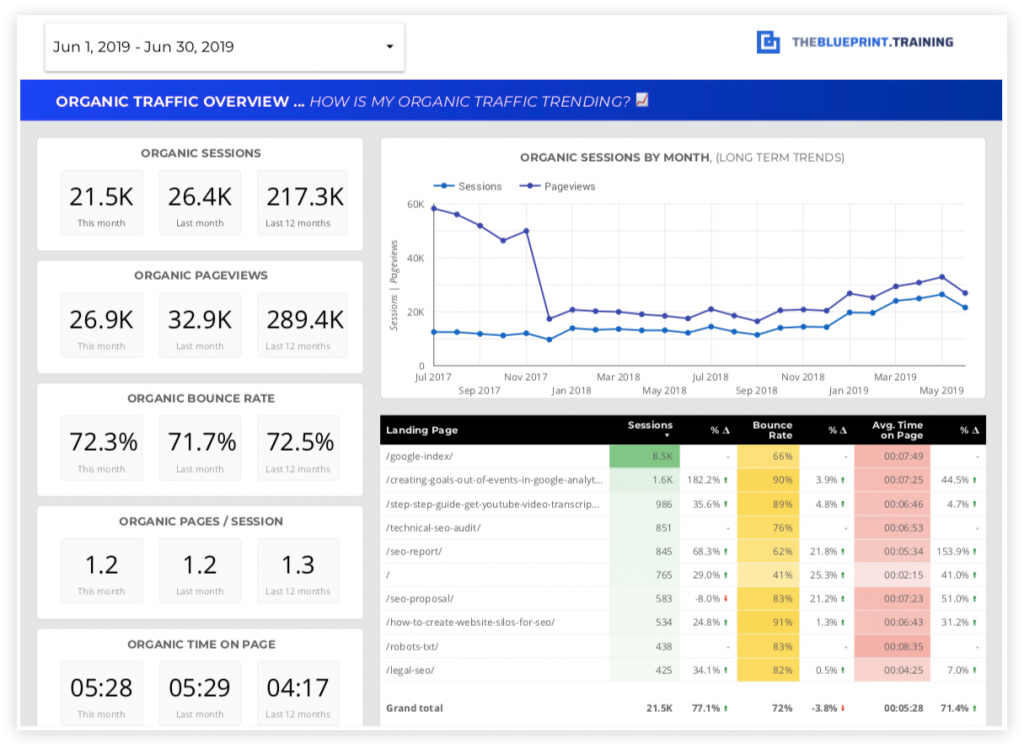
This is why a good SEO report should include high-level metrics like organic impressions and clicks. While this information doesn’t provide much insight into on-page performance, it does offer a jumping-off point for you to talk to your customer about changes in market trends and user behavior.
I like to cover high-level data at the start of each reporting call to set the table for more detailed discussions with customers. I’ve used this data to recommend additional work for clients and use these metrics to show YoY improvement, and justify work during specific periods.
I present data from Google Search Console and Google Analytics to help my clients understand how we can influence their site’s overall performance. Here are a few points that I touch on based on current click and impressions:
- What it means: Impressions = how often content appears, clicks = how many times people click on SERPs.
- Where to find it: Google Search Console
- When to use it: Identify content and build approach. Build sprints to address problem areas. Pages that are performing between 3-12 should be optimized, and low CTR …read more
Source:: Moz Blog