What 5 Recent Search Marketing Changes Mean For B2B Marketers


By Lane Ellis

How can B2B marketers adapt to the latest changes in search engine marketing?
Google, Bing, and other search engines have continued to refine their services, bringing changes that B2B marketers need to be aware of.
Holding the dual roles of the world’s most popular search engine and its biggest search advertising provider, Google and its parent company Alphabet saw an especially strong 70 percent increase in advertising revenue during the second quarter of 2021, the firms recently disclosed. That equates to some $560 million is advertising revenue per day during the quarter, and a year-over-year increase of 62 percent, rebounding from the firm’s only revenue decline a year ago due to the global health crisis.
Search advertising revenue alone rose by 68 percent and accounted for some $38.8 billion during the reporting period, making it as clear as ever that paid search ads continue to be used as an important part of the marketing strategies of both B2C and B2B firms.
The recently-released 2020-2021 edition of the ACSI (American Customer Satisfaction Index) shows some of the reasons why Google’s search remains essentially a de-facto element in marketing efforts, and reinforces Google’s continuing dominance, topping the customer experience list with a score of 76 out of 100.
Microsoft’s Bing wasn’t far behind Google in the index rating, however, with a customer experience score of 71.
Let’s take a look at five of the most recent changes among Google and Bing that are likely to affect B2B marketers, and how they may play out as we push ahead towards 2022.
1 — Google’s “About This Result” & Feedback Features
Google recently introduced a new search feature that now shows some of the reasons why it ranked a specific search result in the position it was discovered, via the three dot additional options section to the right of most search results.
This new list of certain factors taken into account by Google for individual search results launched in late July, and reveals information that can include:
- Matching Keywords
- Related Terms
- Looking-at Links
- Local Relevance
Not all search engine result page (SERP) entries contain data from all four categories, however each piece of information shown can certainly help B2B marketers determine some of the factors Google has considered in relation to a particular search result, such as this example:
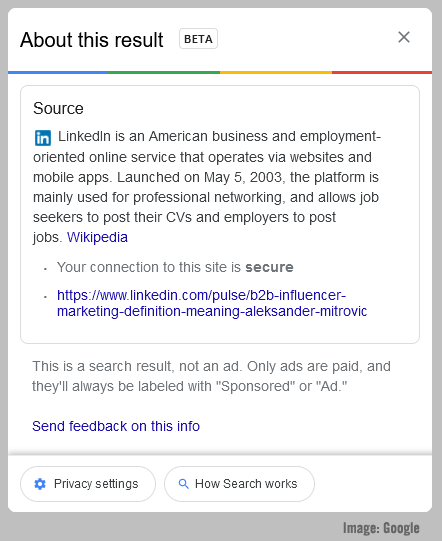
The “looking at links” information shows, according to Google, “When other pages link to a page using similar words as your query, that page might be relevant to your search. It can also be a helpful indicator of whether online content creators tend to regard the page as useful for that topic.”
The option to send feedback to Google on a particular SERP entry may also offer B2B marketers a route to providing additional insight about an indexed page — or perhaps even on competitor pages, as was discussed on the WebmasterWorld message forums.
Some …read more
Source:: Top Rank Blog