Beyond Marketing Magic: How Unified Analytics Turns Thought Leadership Into Measurable Growth


By Theresa Meis

Once upon a time, the impact of B2B thought leadership felt like magic. A research report launched, executive perspectives were published, visibility increased — and, ta-da! Pipeline followed. The mechanics were shrouded in mystery.
Modern analytics, however, have pulled back that curtain. B2B marketing leaders can now see how thought leadership influences engagement and pipeline progression — at least in parts.
The challenge is stitching those parts together. Brand engagement appears in one report, campaign data in another, and revenue in CRM systems. What’s often missing is a clear view of how those signals relate.
Unified analytics provides that visibility.
Thought leadership inside the answer engine
Within our Best Answer Marketing framework, thought leadership begins with insight, like original research, proprietary data or a clearly articulated point of view grounded in expertise and proof.
That insight does not remain confined to a single asset. It informs executive perspectives, influencer collaborations, demand programs, sales enablement, and ongoing brand publishing. The same narrative appears in search results, social conversations, webinars, events, and direct outreach.
When influence operates across that many touchpoints, it cannot be captured in a single dashboard.
The measurement gap holding thought leadership back
For multichannel thought leadership programs, this fragmentation limits visibility. As Jane Bartel, Director of Search & Content Marketing at TopRank Marketing, explains:
“Measuring the influence of thought leadership on marketing outcomes means understanding how it advances buyers through the journey and impacts the KPIs that track their progression… Each format and channel produces data points framed around metrics that each tell part of the larger story. To prove the value of thought leadership and to surface insights for optimizations, two things are crucial: unified analytics and a measurement model that translates multiple signals into a cohesive view.”
When engagement, opportunity data, and revenue outcomes remain separated, influence is difficult to quantify. Investment decisions then center on what is easiest to measure. Channel outputs receive attention, while cross-channel influence receives less scrutiny. Bridging brand, demand, and sales data inside one analytical framework makes that influence visible.
What high performers understand about visibility
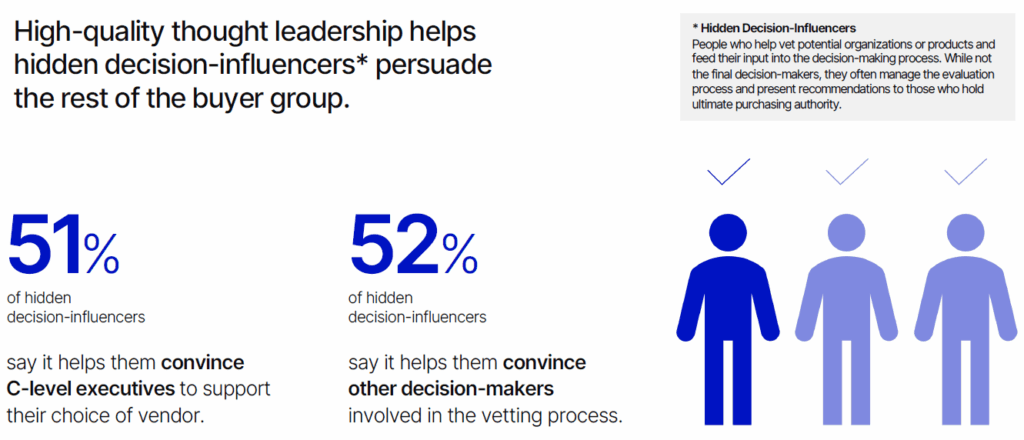
The data reinforces this. In The State of B2B Thought Leadership in 2026, roughly one-third of marketers cite limited visibility into funnel performance as a primary challenge. Another third report over-reliance on a small number of channels

Forty-one percent say difficulty measuring performance is the top reason their content underperforms.
At the same time, higher-performing teams distribute thought leadership across more stages of the buyer journey and are more likely to connect brand activity with revenue outcomes.
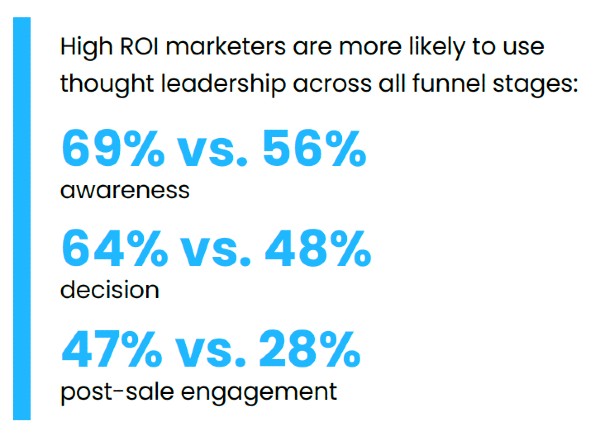
Most B2B marketers aren’t underperforming because they lack effort — they lack integrated visibility.
From impressions to influence: Redefining what success looks like
Multichannel thought leadership generates a range of engagement signals:
- A research report may drive downloads.
- A webinar may deepen exploration of the findings.
- Executive commentary can extend reach.
- Sales teams may reference the same research in active …read more
Source:: Top Rank Blog



Author: Aaron