Answer engine optimization trends in 2026: How AEO is transforming the landscape



Emerging trends in answer engine optimization are reshaping how brands earn visibility, trust, and demand in AI-powered search. Answer engines like ChatGPT, Google AI Overviews, Perplexity, and Gemini now deliver fully synthesized answers directly to users, compressing the traditional customer journey. According to HubSpot’s Consumer Trends Report, 72% of consumers plan to use AI-powered search for shopping more frequently.
If your content isn’t structured for or easily parsed by answer engines, your brand won’t appear. Competitors will. Or worse, inaccurate narratives about your company, pulled from sources you don’t associate with, may surface prominently in AI-driven results. That’s a visibility risk no business can afford.
In this post, I break down the emerging trends in answer engine optimization, why they matter for revenue, and how to integrate AEO with traditional SEO strategies to drive full-funnel growth.
Table of Contents
- Why Emerging Trends in Answer Engine Optimization Matter Now
- 6 Emerging Trends in Answer Engine Optimization You Should Act On
- How to Integrate AEO Strategies With SEO for Full-Funnel Growth
- How to Measure AEO Beyond Rankings and Clicks
- Frequently Asked Questions About Emerging Trends in Answer Engine Optimization
Why Emerging Trends in Answer Engine Optimization Matter Now
Answer engine optimization matters because search behavior is fundamentally changing: AI Overviews reduce organic clicks but increase the value of citations, and conversational assistants are becoming preferred search options for consumers. HubSpot’s Consumer Trends Report reveals that the most significant emotions consumers feel while shopping using generative AI are positive — appreciation, satisfaction, optimism, and joy.
The brands that will win in the future of search are those whose content can be cited, summarized, and reused by AI engines. While traditional search remains important and shouldn’t be abandoned, neglecting AEO creates significant risks for brand visibility and control.
Here’s why it matters.
Brand perception is now shaped before the click.
AEO efforts can influence perception depending on how well the content appears in AI tools. If the facts about your product, pricing, or differentiators are inconsistent across pages, answer engines are less likely to trust or cite you.
What’s worse is that if your brand doesn’t provide the content, someone else will — an unhappy customer on Reddit, for example.
Marketing departments must control their product, service, or brand narrative; they must ensure their content is available for AI tools to summarize and deliver to relevant user queries.
Here’s an example of how third-party sources drive the narrative for HubSpot CRM in AI Overviews: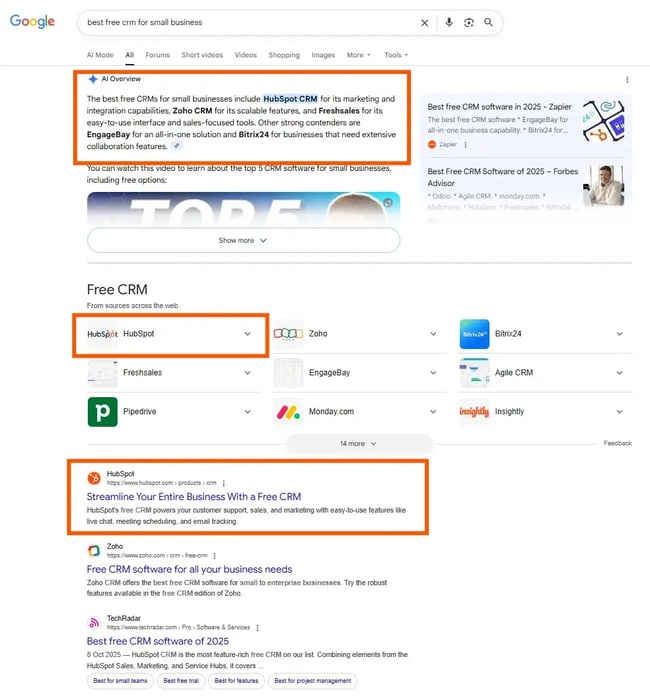
I searched for “best free CRM for small business,” and the AI Overviews recommended HubSpot as the top option. The source cited is Zapier. Directly below AI Overviews, HubSpot appears again, first, in “Sources across the web.” Brand trust …read more
Source:: HubSpot Blog